

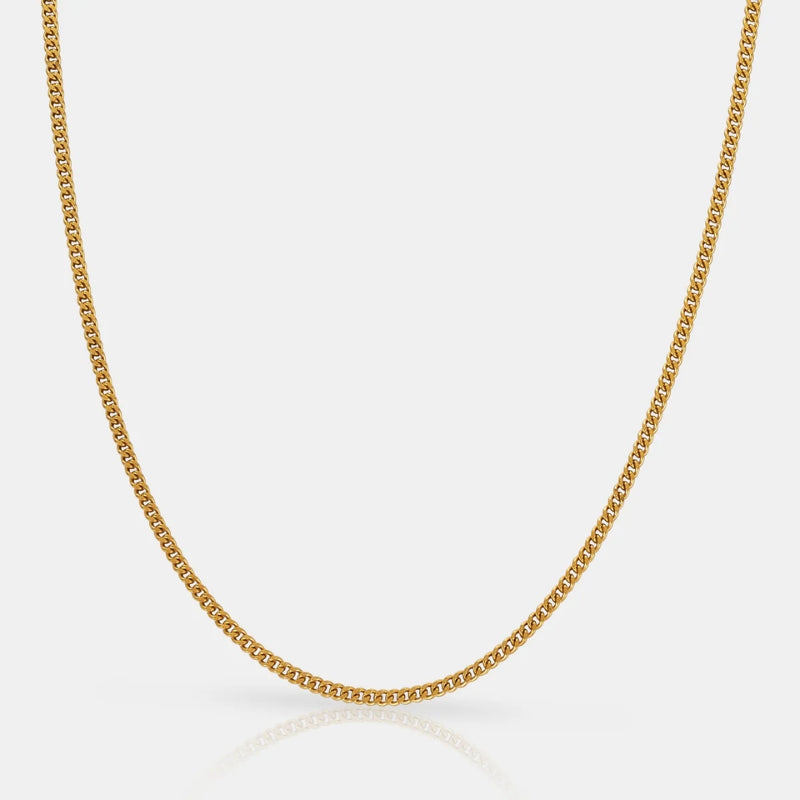
Catena bizantina uomo 2027: guida completa
The Byzantine chain has roots in 4th-century Constantinople.

Roman and early Byzantine goldsmiths developed the chain pattern, which uses small interlinked oval rings arranged in a complex repeated four-link cluster, around the time the Roman Empire split. The chain was a status piece worn by Byzantine court officials and noble women, with surviving examples found in 6th-century archaeological digs. The design has been continuously made for over 1,600 years, making it the oldest chain style still commercially manufactured in men’s jewellery in 2026.
That deep history is part of what makes the Byzantine distinctive. It’s not a 1970s disco invention or a 2000s hip-hop adaptation. It’s a chain men have been wearing in some form since before England existed as a nation.
This is the buying guide for UK men in 2026.
I run Monrich, a UK men’s jewellery brand. Disclosure first.
You can see the current men's chains line-up for reference as you read.
What is a Byzantine chain?

The Byzantine chain is a complex metal chain made of small oval links arranged in a repeating four-link cluster pattern. Each cluster has links going in different directions, interlocked tightly to create a chain with a distinctive squared, woven appearance.
Key features: - Complex four-link cluster construction - Square or rectangular cross-section - High visual texture (no smooth surface) - Heavy weight per linear inch (high metal density) - Strong under tension and impact - Difficult to manufacture (requires precise tooling)
The Byzantine is one of the most intricate chain patterns commercially available. The construction makes the chain expensive to produce relative to simpler chain styles, which is why Byzantine chains are typically positioned at the premium end of the catalogue rather than the entry tier.
History and origins
The Byzantine chain pattern emerged in the Eastern Roman Empire (Byzantium) in the 4th-6th centuries CE. Archaeological finds from Constantinople and other Byzantine cities show the chain construction worn by both men and women in court contexts. The pattern was associated with imperial wealth and status.
The chain spread through the Mediterranean world during Byzantine influence, then was preserved in Italian goldsmithing traditions through the Middle Ages and Renaissance. Italian craftsmen in Genoa, Florence, and later Vicenza kept the technique alive when other Byzantine arts were lost to history.
By the 19th century the Byzantine chain had become a recognised European fine jewellery style. By the 20th century it was a global classic, particularly in solid gold versions. By 2026, the Byzantine sits in a premium niche in UK men’s jewellery, common in solid gold pieces, less common in plated stainless versions because of the manufacturing complexity.
Byzantine chains are constructed by linking small oval rings in a repeating four-link cluster pattern.
Construction details

Byzantine chains are constructed by linking small oval rings in a repeating four-link cluster pattern. Each cluster has rings going in alternating directions, interlocked so the chain reads as a continuous braided structure rather than separate clusters.
The construction makes Byzantine chains: - Visually heavy: dense link pattern creates substantial visual presence - Physically heavy: more metal per linear inch than simpler chain styles - Strong under tension: distributed load across many interlocked links - Difficult to break: very few weak points along the chain length - Hard to repair: complex construction requires specialist goldsmith for repair
The Byzantine’s complexity makes it more expensive to manufacture than Cuban or curb chains at the same weight. This cost premium is reflected in retail pricing.
Sizing for men
Byzantine chain widths for UK men: - 3-4mm: subtle compared to other Byzantine sizes, layered styling - 5-6mm: balanced everyday wear (most common size) - 7-8mm: confident statement, premium positioning - 9-12mm: heavy statement, typically solid gold only
The Byzantine reads visually larger than other chain styles at the same physical width because of the dense link cluster pattern. A 5mm Byzantine looks similar to a 6-7mm Cuban from across a room.
Lengths: - 18-20”: collarbone, formal styling - 22-24”: mid-chest, most versatile - 26”+: lower chest, statement layering
The Byzantine reads visually larger than other chain styles at the same physical width because of the dense link cluster pattern. A 5mm Byzantine looks similar to a 6-7mm Cuban from across a room.
Materials and finishes

Common UK 2026 Byzantine chain materials: - PVD-plated 316L stainless steel: £60-£180 (premium pricing for Byzantine specifically) - Sterling silver: £150-£500 - Gold vermeil: £200-£600 - Solid 9K-18K gold: £800-£5,000+
The Byzantine commands roughly 30-50% premium over Cuban chains at the same width and length, reflecting the manufacturing complexity. Even in PVD-plated 316L, Byzantine chains sit at the higher end of the catalogue.
Finishes: - High-polish (default, shows the intricate construction) - Diamond-cut (extra faceting, less common because the construction is already textured) - Brushed (uncommon, dulls the link detail)
How to wear it
Styling rules:
-
Heritage styling: Byzantine chains pair naturally with traditional menswear (tailored suits, dress shirts, leather jackets). The chain reads as refined heritage piece rather than streetwear.
-
Limit layering: the dense visual texture of the Byzantine doesn’t benefit from heavy layering. Wear as primary chain or with one subtle additional chain.
-
Match pendant scale: small simple pendants (initial disc, coordinate disc, small cross) work best. Avoid ornate pendants that compete with the chain’s natural texture.
-
Formal contexts: Byzantine chains work at weddings, formal evenings, and business contexts particularly well. The heritage detailing reads as established style.
-
Match metal tone: Byzantine chains look best in single-tone (all gold or all silver). Two-tone Byzantine construction exists but is harder to style cleanly.
For accessible PVD-plated 316L Byzantine chains: - Monrich Byzantine range: £60-£150 (BOGO) - Craftd London: £80-£200 (limited Byzantine selection)
Brand picks UK 2026
For accessible PVD-plated 316L Byzantine chains: - Monrich Byzantine range: £60-£150 (BOGO) - Craftd London: £80-£200 (limited Byzantine selection)
For sterling silver Byzantine chains: - Hatton Labs: £250-£600 - Mejuri Men: £200-£450 plus Toronto customs - Tom Wood: £200-£500 plus Oslo customs
For solid gold Byzantine chains (premium pricing reflecting Italian craftsmanship): - Hatton Garden specialists - Goldsmiths (premium counter) - Steven Stone (Italian heritage focus)
Price range
UK 2026 Byzantine chain prices: - Budget (under £40): typically poor-quality electroplated construction, the complex Byzantine pattern is hard to manufacture cheaply - Mid (£60-£150): PVD-plated 316L (recommended for daily wear) - Premium (£150-£300): sterling silver, thicker PVD - Designer (£300-£700): designer sterling silver, vermeil Italian heritage - Luxury (£800-£5,000+): solid 9K-18K gold
For UK men in 2026 wanting a Byzantine chain without committing to solid gold prices, the £80-£150 PVD-plated 316L band offers the best balance.
For UK men in 2026 wanting a Byzantine chain without committing to solid gold prices, the £80-£150 PVD-plated 316L band offers the best balance.
The collector's chain
There’s a specific kind of buyer the Byzantine chain disproportionately attracts.
The collector. Not necessarily a jewellery collector specifically, but a man who collects something with depth, vintage watches, first-edition books, specific guitar models, classic cars. The Byzantine’s combination of historical depth (1,600+ years of continuous manufacture), construction complexity, and material density appeals to the collector’s instinct for objects with substance beyond the surface.
This isn’t marketing language. Walk into any Hatton Garden specialist and ask about the Byzantine chain. The salesperson will likely tell you which Italian workshop produces theirs, how the construction differs from cheaper imitations, and what the heritage of the design represents. The chain invites that depth of conversation in a way Cuban chains rarely do.
For collectors, the Byzantine’s premium price (30-50% above comparable Cuban chains) is reasonable because it’s buying access to depth. You’re paying for the heritage, the construction, the connection to a continuous craft tradition. The chain becomes one piece in a wardrobe where every piece has a story.
For non-collectors, the Byzantine’s premium is harder to justify because the visible aesthetic upgrade over a Cuban at the same width is subtle. The chain looks rich, but rich in a way that takes attention to notice. A collector notices and values the detail. A buyer wanting visible statement value gets more impact from a chunkier Cuban at the same price.
The honest test: are you the kind of man who appreciates things that reward close attention over things that demand it? If yes, the Byzantine is built for you. If no, the Cuban is the more honest match.
FAQs
Is the Byzantine chain in style in 2026?
Yes, in a niche heritage-styling position. Not mainstream like Cuban but recognised as a refined classical alternative. Popular among men with Mediterranean or Italian heritage and men with traditional menswear preferences.
Is the Byzantine chain masculine?
Strongly so in heritage and traditional menswear styling. The complex construction reads as established craftsmanship rather than fashion-forward. Worn historically by Byzantine emperors and Italian-American men in established wealth contexts.
Why is the Byzantine chain more expensive than Cuban?
Manufacturing complexity. The four-link cluster pattern requires more precise tooling, more material per linear inch, and longer production time than simpler Cuban or curb chains. The price premium reflects real production cost.
Is the Byzantine chain durable?
Yes. The complex link construction has many interlocked points distributing load. A solid gold Byzantine chain can last centuries (and many do, from 6th-century examples to modern pieces). PVD-plated 316L Byzantine chains last 3-7 years depending on wear conditions.
Can I wear a pendant on a Byzantine chain?
Yes, with small to medium pendants. The dense Byzantine texture provides strong pendant support. Avoid large or ornate pendants that compete visually with the chain’s natural texture.
What length is best for a Byzantine chain?
22-24” is the most versatile length, placing the chain at mid-chest where the intricate construction is fully visible. 18-20” works for higher placement near the collarbone for more formal styling.
Built after wearing the others.
Different by design.
PVD-plated 316L. 1-2 micron thickness declared. 12-month tarnish guarantee in writing. Permanent buy one get one free across the full catalogue.
Browse Monrich → UK shipping 2-4 days / 30-day returns / no customs


